

The following deep-dive explainer post is my attempt to explain the problems we’re currently seeing regarding oversight of policing, especially when it comes to Federal agencies such as ICE. This is part of the series on Police Accountability and Federal Overreach.
The Illusion of Accountability
When something goes wrong in policing, most of us reach for the same explanations. The officers weren’t trained well enough. The department needs better policies. Leadership failed. If we just fix those things, if we just had more training, clearer rules, and stronger supervision, then accountability will be inevitable.
That explanation is comforting to many people, but the underlying assumption is that the system basically works and just needs improvement.
But more often than we care to admit, accountability doesn’t fail because of bad individuals or missing policies. Accountability fails because the system itself is structured in a way that prevents it.
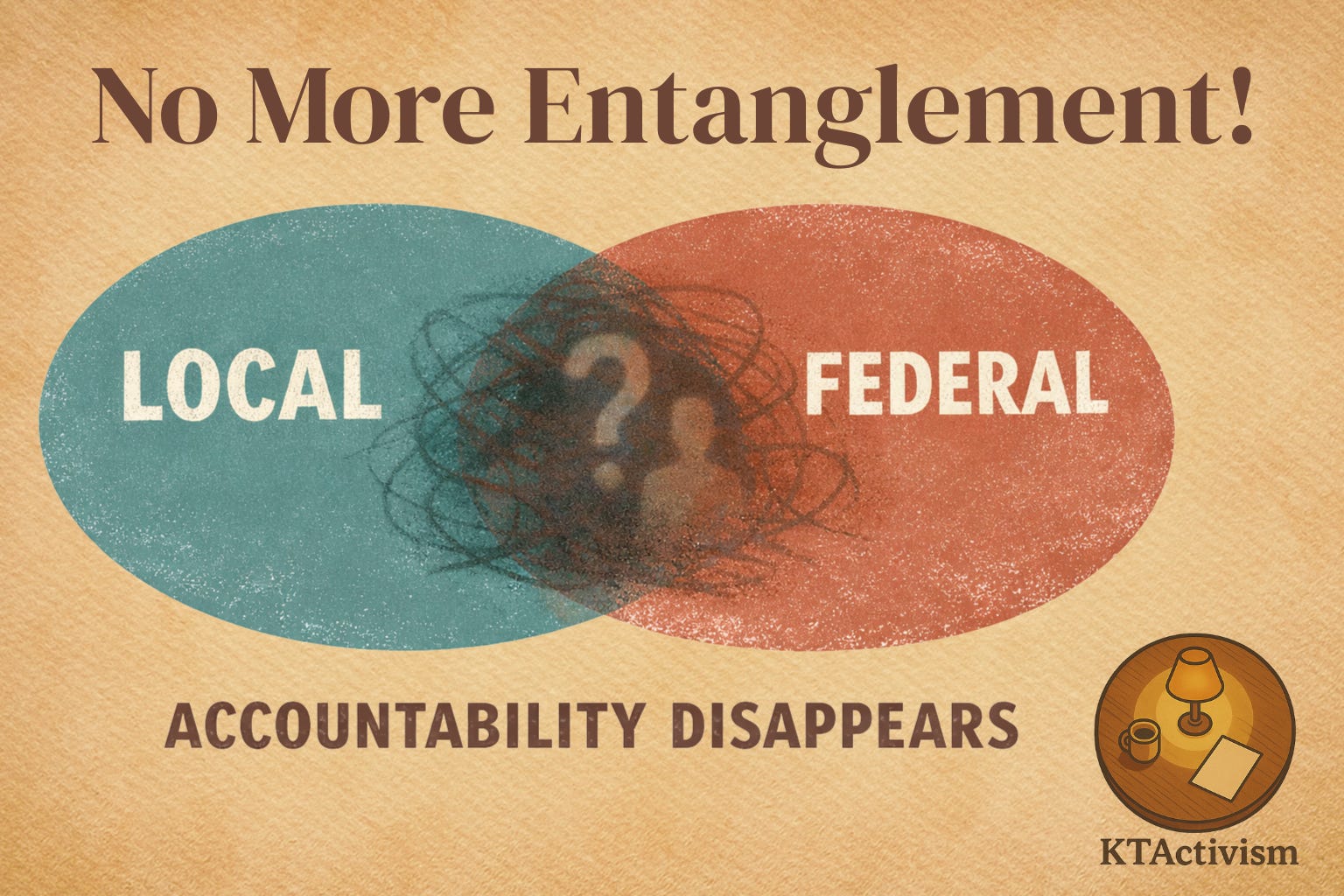
When authority is shared across overlapping systems, such as local police, federal agencies, and joint task forces, responsibility becomes blurred. If you pause to think about this, it makes perfect sense. When responsibility is blurred, accountability doesn’t just weaken. It breaks.
That’s the core problem we’re dealing with this month: entanglement.
Recent history has demonstrated that reform repeatedly fails under entanglement. You may have seen similar examples of this where you work: when everyone is in charge, no one is accountable when the shit hits the fan. Everything quickly dissolves into finger-pointing, blaming, and deflection.
The simple fact is that when multiple systems share power without clear lines of authority, meaningful accountability becomes nearly impossible. In those cases, structural separation is often required.
What “Entanglement” Actually Means
Entanglement sounds abstract, but it shows up in very concrete ways.
It happens when local police departments are woven into federal systems through:
joint task forces
deputization agreements
shared intelligence platforms
federal funding streams
coordinated operations
On paper, this looks like cooperation. In practice, it creates overlapping authority structures where no one is fully in charge and everyone can defer responsibility. For an agency that wants to operate with impunity in support of unpopular goals, this is an ideal situation. They can claim this is about cooperation and mutual support, while knowing full well it leads to a lack of accountability that grants them virtual immunity when they violate laws or ethical norms.
Local officers are still accountable to their communities, at least in theory. But they are also operating within federal chains of command, responding to federal priorities, and often relying on federal resources. That creates what we might call split loyalties.
If you completed the action “Map Federal Entanglement in Your Local Police,” you’ve already seen how this can show up in your own community. It’s not rare. It’s not hidden. In fact, it’s often right there on department websites and in its press releases. They aren’t trying to hide it, likely because they simply don’t understand the negative consequences of entanglement.
The question is not whether entanglement exists. The question is, what does entanglement do to accountability?
Why Shared Systems Destroy Accountability
No One Is Clearly in Charge
One thing I learned from spending almost 40 years working in the private, non-profit, and public sectors is that when authority is shared, responsibility becomes negotiable and true accountability is almost impossible.
During the 2020 racial justice protests in Portland, the federal government deployed agents from the Department of Homeland Security to operate in the city. These agents, drawn from units like BORTAC and the Federal Protective Service, conducted operations blocks away from federal property, including using unmarked vans to apprehend and detain protesters.
Local police were present in the broader environment, but the lines of authority were blurred. Federal agents claimed they were operating under federal jurisdiction. Local officials argued they didn’t control federal tactics. Each side pointed to the other when questions of responsibility arose.
What followed was an accountability vacuum. If no one is responsible, how do you begin to assign accountability? Local oversight bodies couldn’t compel federal agents to testify or comply with local standards. Federal agencies largely investigated themselves. Lawsuits were filed, but responsibility remained fragmented across jurisdictions.
Regardless of how someone views the protests themselves, the structural problem is clear: when no one is clearly in charge, no one can be held fully accountable.
Oversight Systems Don’t Match the Structure
Most oversight systems are designed for a single chain of command. A city can investigate its police department. A state can review local conduct. Federal agencies can oversee federal actors.
But entangled systems don’t follow those lines.
Local oversight cannot reach federal agents. Federal oversight is often slower, more limited, and frequently internal. (Or, as we’ve seen recently, Federal oversight is simply non-existent because the current regime doesn’t care about following laws and norms in pursuit of their goals.) When actions involve both systems, they fall into the gaps between them.
In Portland, that gap was not theoretical. It was the reality. The system did not fail to hold people accountable because no one cared. It failed because no single body had clear authority to act.
Inaction Becomes Participation
Entanglement also changes the meaning of inaction.
When local officers are present during federal operations and choose not to intervene, that decision is often framed as neutrality. “It’s not our jurisdiction.” “We don’t have authority over federal agents.”
But as you saw in the action “Identify Your Local Accomplice-Liability Laws,” many state laws already recognize that inaction can carry responsibility. A person who knows a harmful act is occurring and has the ability to intervene (or at least report it) may still bear legal and moral responsibility for what follows.
When systems are entangled, responsibility is spread so widely that individuals feel less compelled to act. The structure itself discourages intervention. And when everyone steps back, harm just keeps on rolling forward.
Why “Better Training” Doesn’t Fix This
One of the most persistent ideas I’ve come across in discussions about policing is that better training will solve these problems. Proponents believe that better training will lead to more de-escalation. More community engagement. More awareness of rights and responsibilities.
Training matters and I fully support it, especially ongoing training to reinforce positive policing. But it only works when the system allows people to use what they’ve learned.
In an entangled system, officers are often operating within constraints that override their training. They may not have the authority to countermand federal actions. They may be instructed to defer. They may face institutional pressure to comply with joint operations rather than challenge them.
The Portland example makes this clear. Even if local officers had been perfectly trained in de-escalation and civil rights protections, they were not in a position to override federal tactics. The structure itself placed them on the sidelines.
You can’t train your way out of a structural constraint.
How Entanglement Protects Misconduct
Federal Priorities Override Local Needs
Programs like 287(g) agreements illustrate this dynamic in a different context.
Under these agreements, local officers are deputized to perform federal immigration enforcement functions. On paper, this expands capacity. In practice, it blurs roles and shifts priorities. If everyone plays by the rules and follows laws, policies, and norms, this blurring of roles may not be noticeable. But during times of Federal overreach and use of legally questionable (or clearly illegal) tactics, this blurring of roles and shifting of priorities exposes massive problems.
In cities like Charlotte or Miami-Dade, local leaders have often tried to build trust with immigrant communities to improve public safety. That trust encourages people to report crimes, cooperate with investigations, and engage with local institutions.
But once officers are entangled with federal immigration enforcement, those local priorities are overridden. Routine interactions, such as traffic stops, minor arrests, or even jail intake, can become entry points into deportation pipelines.
This changes behavior on both sides. Community members become less likely to report crimes. Officers spend more time on immigration-related processes and less time on local safety concerns. These changes make neighborhoods and communities less safe, which means that aggressive deportation operations are making cities less safe, which is directly opposite of their alleged primary goal.
The system has shifted because of Federal entanglement, and local leaders cannot fully control it.
Resources Get Redirected
Entanglement also changes how resources are used.
Time and personnel devoted to federal priorities are time and personnel not available for local needs. Officers processing immigration paperwork are not responding to emergency calls. Units participating in joint operations are not focused on community-level safety.
This is not just a civil rights issue. It is a public safety issue. What we’re seeing is that when priorities are set externally, local safety suffers.
Accountability Becomes Diffuse
Perhaps most importantly, entanglement makes it harder for the public to know where to direct accountability.
If something goes wrong, who is responsible?
The mayor?
The police chief?
The sheriff?
A federal agency?
When responsibility is unclear, accountability weakens. People may be angry, but they don’t know where to aim that anger in a way that produces the positive change that’s needed.
What Actually Works: Structural Separation
If entanglement is the problem, then the solution can’t be limited to better policies layered on top of it. It’s a clear example of the proverbial “putting lipstick on a pig.”
Why Reform Falls Short
Reform is not bad, in and of itself, but effective reform requires a stable structure. It assumes that accountability mechanisms can operate within the existing system. It assumes that authority is clear enough for those mechanisms to function.
Entanglement undermines all of those assumptions.
When you layer reforms onto a system with blurred authority, those reforms are often absorbed without changing outcomes. The structure remains intact, and the same problems reappear.
Camden as Proof of Concept
Camden, New Jersey, offers a different approach.
In 2013, the city decided it wouldn’t attempt to incrementally reform its police department. It dissolved the police department entirely and rebuilt a new department at the county level with new leadership, new contracts, and a new operational philosophy.
This was not a cosmetic change. They didn’t need lipstick because they simply got rid of the pig! What Camden did was a complete structural reset. By breaking from the existing system, the city was able to implement policies and practices that had previously been blocked by entrenched structures.
The results were measurable. Violent crime decreased. Use-of-force incidents declined. Community engagement improved. Years of attempted reforms had failed to do this.
The key lesson is not that Camden is perfect. It is that meaningful change occurred because the structure changed. Reform alone would not have produced the same outcome.
What Separation Looks Like
Structural separation doesn’t always mean dissolving a department. It can take many forms:
ending participation in certain federal task forces
prohibiting specific types of federal entanglement
building independent response systems for non-violent calls
creating oversight bodies with real authority
The common thread is clarity. Clear lines of authority. Clear responsibility. Clear accountability. Structural separation eliminates the blurriness caused by entanglement.
So What?
Okay… so what? Why should we care about any of this?
Well, we should care about this because accountability without clear responsibility is an illusion. If no one is clearly in charge, no one can be held accountable when things go wrong.
This is important because entanglement allows harm without consequence. When systems overlap, actions fall through the cracks, and misconduct becomes harder to address.
We should care about this because public safety is weakened when priorities are distorted. When local resources are redirected toward federal goals, communities lose the protection they expect.
And this matters because reform will keep failing if we don’t address structure. We can train, retrain, and rewrite policies, but if the underlying system remains entangled, the results will not fundamentally change.
If we keep trying to fix behavior without fixing structure, we’ll just keep getting the same results, no matter how good our intentions are.
Now What?
This is where Kitchen Table Activism comes in.
You don’t need to solve the entire system. You just need to understand where leverage exists.
This topic’s weekly actions are designed to help you do exactly that:
mapping where entanglement exists in your community
understanding the legal frameworks that govern responsibility
identifying how funding shapes behavior (coming soon)
applying targeted pressure where it can make a difference (coming soon)
Each step builds on the last. Each one increases your clarity and your ability to act.
Alignment with Values
At its core, this issue is about values.
Do our systems serve the people, or do they protect unethical actors from accountability?
Clarity, responsibility, and fairness are not abstract ideals. They are design choices with real world impacts. When we build systems that blur responsibility, we shouldn’t be surprised when accountability disappears. Luckily, you’re learning what needs to be done to assign clear responsibility and build true accountability into Federal and local policing.
One of my key suggestions is to stay focused on your values and the values that should be built into our civic systems. Because the work ahead is not about outrage. It’s about alignment—bringing our systems back into alignment with the values we claim to hold.
That work doesn’t start in Washington. It starts at the kitchen table!
For a refresher on what you can do to support issues you care deeply about, spend some time reviewing my Guide to Kitchen Table Activism. It contains tools, templates, and tactics you can use in 15 minutes… right from your kitchen table.