

The following post is supplemental to this week’s podcast episodes. For the full discussion, check out this week’s episode of Afterthoughts: The Gospel of Empire, and share your honest thoughts in the comments section below.
Walk into almost any Christian church on any given Sunday and you’re likely to hear something in the sermon that praises community. You’ll hear about a love that crosses borders, unites humanity, and inspires believers to take the gospel to the ends of the earth. In Christian tradition, Matthew 28:16-20, the “Great Commission,” is treated as the ultimate blueprint for global charity and solidarity.
They couldn’t be more wrong because history tells a radically different, far more blood-soaked story.
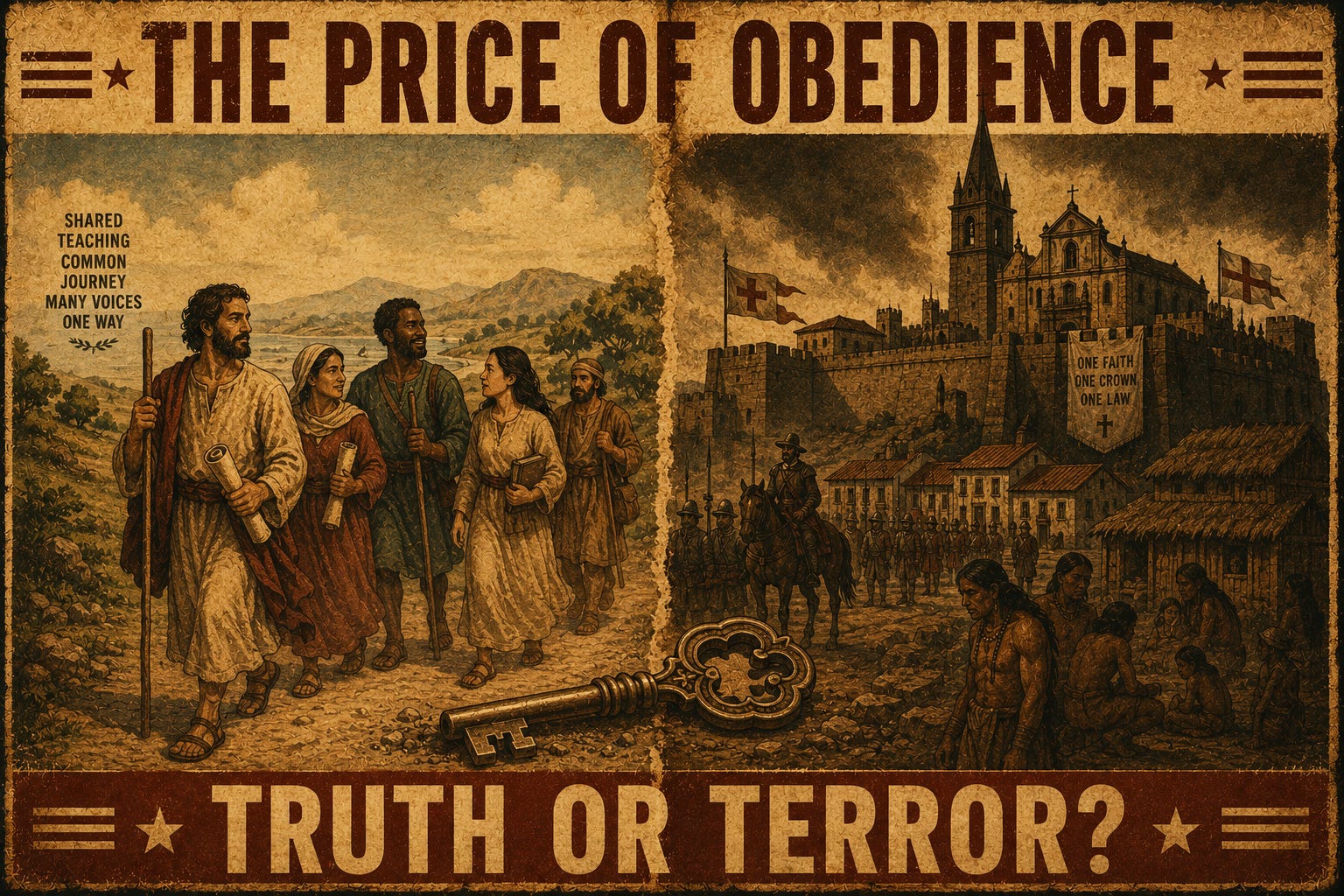
When we look past the stained glass version of the Great Commission, we see a rather disturbing reality: the mandate to “make disciples of all nations” provided the ideological, legal, and psychological operating system for global supremacy and cultural erasure. On this week’s episode of Afterthoughts, The Gospel of Empire, we stripped away the supernatural veneer to confront the toxic framework that mainstream believers routinely ignore.
To explore this topic even deeper, I think we need to wrestle with three rather devastating questions that challenge the very core of Western religious outreach.
So, let’s do that right now!
Question 1: If love requires conversion, is it love or a hostile takeover?
The Great Commission establishes what amounts to a non-reciprocal framework. It forces an immediate hierarchy: one group possesses the absolute, exclusive truth, while the rest of the world is reduced to a “project” to be managed, converted, or spiritually conquered.
True human community requires an equal partnership. Community requires a mutual exchange where both parties are willing to listen and learn. But the Matthean mandate explicitly forbids reciprocity. A missionary cannot accept wisdom from an Indigenous elder; they can only deposit their own dogma. It’s a one-way relationship with no room for reciprocity.
When your affection for another human being is intrinsically tied to a desire to change their fundamental identity, culture, or worldview, it ceases to be benevolence. It becomes an ideological hostile takeover. It reduces another person to being the “other” who has a deficit that needs fixing. In short, operating from within this theological model means you cannot love people for who they actually are.
The mandate to “make disciples of all nations” provided the ideological, legal, and psychological operating system for global supremacy and cultural erasure.
Question 2. Why fund global missions instead of paying historical reparations?
The connection between Christian scripture and global atrocities is not a historical accident or an unlucky correlation. It is causation. In the 15th century, the Vatican issued a series of papal decrees known as the Doctrine of Discovery. These documents explicitly cited the absolute authority granted in Matthew 28 to give European explorers legal permission to seize non-Christian lands and “reduce their persons to perpetual slavery.”
From the trans-Atlantic slave trade to the horrific residential and boarding school systems in North America, empires used the Great Commission to justify cultural genocide. To “teach them to obey everything” meant doing things like forcibly cutting children’s hair, banning indigenous languages, and destroying familial structures. And all of this was done under the guise of Christian love.
This well-documented history should cause a massive crisis of accountability for modern churches. If mainstream religious institutions acknowledge that their foundational mandate was the operating system used to justify global theft and violence, the hypocrisy is glaring. Why are they still spending billions annually funding programs like short-term youth mission trips instead of using their massive institutional wealth to pay systemic reparations to the very communities they tried to destroy? (Hint: It’s because they’re still using this toxic operating system while ignoring the past and repairing the veneer.)
Question 3. Can a pluralistic world survive a mandate for absolute homogeneity?
The short answer: no.
We live in a deeply interconnected, diverse global society. The survival of humanity depends on our ability to cooperate across ideological, political, and cultural divides. Humanism teaches us that community is built on shared human needs—things like food, safety, art, respect, and love—without requiring anyone to surrender their worldview.
The Great Commission is fundamentally incompatible with this democratic reality. It operates on an existential ultimatum: absolute, global homogeneity. It views every cultural difference, every alternative wisdom tradition, and every secular space not as a valid expression of human life, but as a target for spiritual conquest.
Can a global human family ever truly survive when one of its largest segments operates under a command that explicitly forbids mutual learning? The historical and modern legacy of cosmic colonialism suggests that as long as religious groups prioritize ideological conversion over ethical solidarity, true community will remain entirely out of reach.
My Final Thoughts on This
To be completely clear, even though I no longer believe in the supernatural, I don’t expect everyone to drop their religion or give up their spiritual beliefs. It would be incredibly hypocritical of me to stand here arguing for plurality and diversity, and then turn around and expect everyone to agree with me on everything.
I’m also not one of those people who insists that to be considered a Christian, you have to blindly believe every single word written in your Scriptures. In fact, I would love to see more Christians explore what it means to be a “Values-Based Christian.” Instead of fighting to defend the idea that the Bible (with its hundreds of different translations) is the literal, inerrant word of God, why not approach it as an inspired collection of works from an old wisdom tradition? That’s basically what I try to do every single week with Mythologizing the Bible.
Of course, if shifting that perspective feels like too much of a leap for you, that’s totally fine. All I ask is that you don’t look down on the people who don’t share your unprovable supernatural beliefs, whether they have no religious beliefs at all, or whether they have a different set of supernatural beliefs than your own. We might not find a lot of common ground in our theology, but we can absolutely use our shared core values to build a solid common floor that will stabilize and support all of us.
What does true pluralism look like to you? Can we actually build that common floor together, or are we still quietly trying to remake each other in our own image?
For instance, when a well-meaning believer tells an out-and-proud atheist, “I’m praying that God will keep using your life for good,” are they actually respecting that person’s worldview, or are they just forcing a secular life into a religious box?
Let’s talk about it. Listen to the full discussion on this week’s episode of Afterthoughts: The Gospel of Empire, and share your honest thoughts in the comments section below.