

When life falls apart, religion often offers a simple answer: pray, trust God, and wait for things to work out.
But what if you don’t believe in divine intervention? What if you still need hope, strength, and practical ways to get through hard moments without a belief in the supernatural?
That’s where a humanist resilience toolkit comes in.
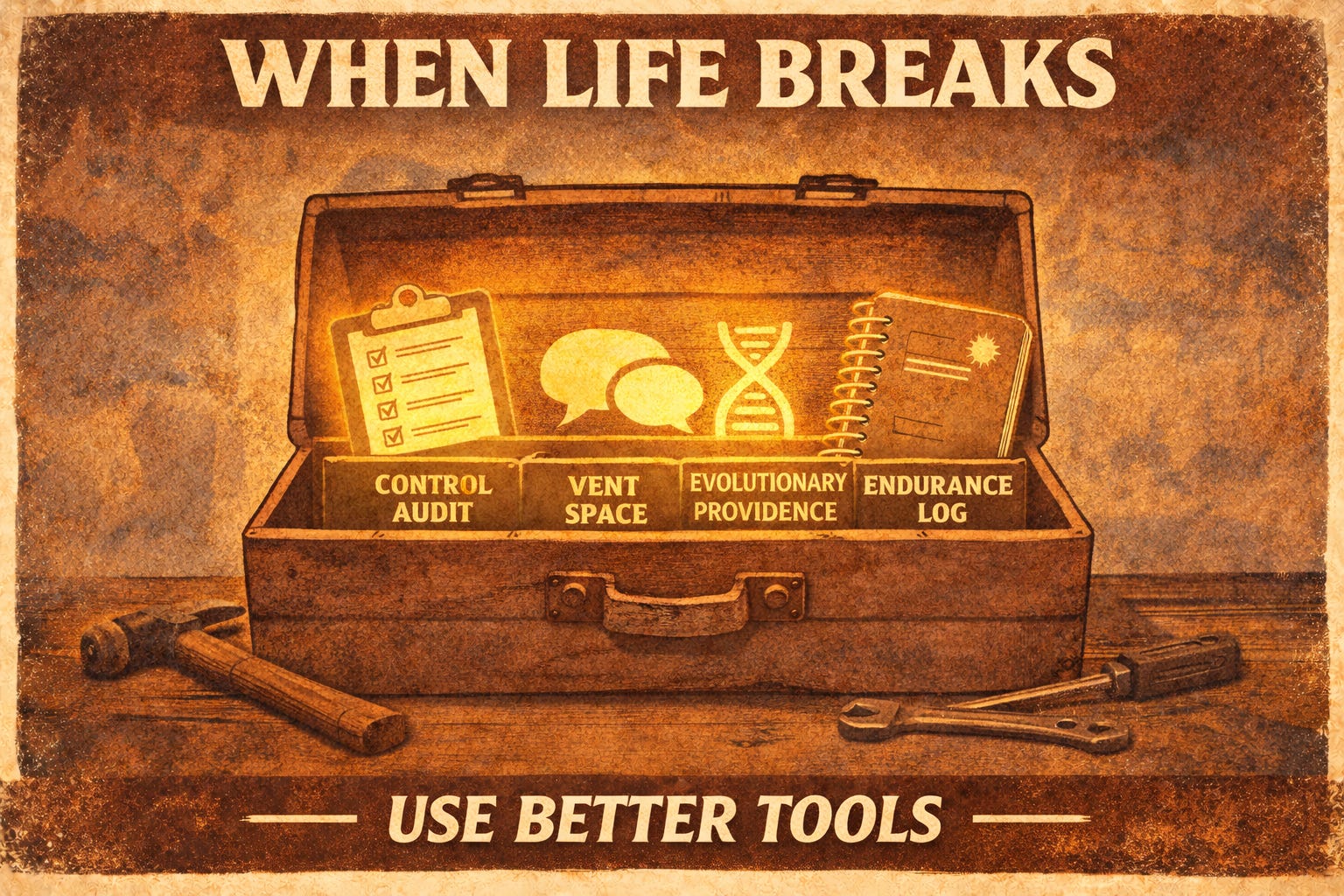
These are practical tools and experiments designed to help you navigate difficult situations without relying on the supernatural. Instead, they draw on three things that humans actually possess: agency, community, and the resilience written into our biology.
Below are three tools and three small experiments you can begin using right away.
The Toolkit
Tools
Control Audit: Shift from panic to problem-solving by focusing only on what you can control.
Vent Space: Create a safe, intentional space where someone can witness your struggle without trying to “fix” it.
Evolutionary Providence Reflection: Remember that you are the product of 4 billion years of survival and adaptation.
Experiments
The “Third Way” Reframing: Help others rediscover their own strength in moments of crisis.
Common Well Nights: Build human connection across differences.
Endurance Log: Document how you survive hard moments so you never forget your resilience.
Okay, let’s take a look at each one of these in more detail.
Tool #1: Control Audit
This one is simple, but incredibly powerful. When a crisis hits, sit down with a notebook, alone or with someone from your Circle, and draw two columns:
Column One: What is outside your control?
Column Two: What is within your control?
Most people default to obsessing over the first column… but those are the problems we can’t fix, the decisions someone else will make, or the outcomes we can’t influence. Spending our time and energy on the things in this column can send us into a tailspin.
A Control Audit interrupts that spiral. The key is to identify both things outside your control and within your control, and then focus on whatever is within your control.
It moves your brain from panic mode to problem-solving mode. Instead of wasting energy on the uncontrollable, you redirect attention to actions you can actually take.
In other words: Stop cursing the weather and start steering the ship.
Tool #2: Vent Space
Religion has prayer, which often functions as a way to lament and release emotional pressure. Humanism needs something similar. Not supernatural, of course, but definitely a method that is intentional.
To do that, you can create what I call a Vent Space.
This is a time and place where you can open up and release your frustration, grief, or anger in the presence of another human being. It’s important to be in the presence of someone who cares about you so that your feelings are “witnessed” and accepted.
The key rule: this is not a problem-solving session.
For example:
Go for a run with a friend and tell them beforehand: “I just need to vent.”
Invite someone over for a drink and say: “Tonight I need to talk and I just need you to listen.”
No advice. No fixing. No theology. Just presence.
Sometimes the most powerful thing another person can do is simply witness your pain. You have the power to facilitate that by creating a “vent space.”
Tool #3: Reflect on Evolutionary Providence
Religion teaches divine providence, which is the belief that a supernatural force is guiding events. Humanism offers something even more remarkable: evolutionary providence.
Think about it:
You are the product of 4 billion years of successful adaptation and survival!
Your ancestors endured ice ages, droughts, disease, war, famine, predators, and so much more. That resilience isn’t metaphorical, it’s cellular. Every crisis you face today is being confronted by a body and mind built from an unbroken chain of survivors.
To help reflect on this idea, try listening to the meditation “The Legacy of Ancestors.”
Evolutionary Providence: Legacy of Ancestors

When life feels overwhelming, many people look upward for reassurance. But what if the real source of strength lies behind you, in the countless generations that survived long enough for you to exist? This short guided reflection invites you to pause, breathe, and remember the extraordinary legacy of resilience written into your own body!
The next time life hits you with something brutal (and it will) remember this: You come from 4 billion years of people who made it through.
Your survival isn’t miraculous. It’s ancestral momentum.
Three Experiments for Daily Life
Tools are helpful but resilience grows through practice. Here are three small experiments you can try this week.
Experiment #1: The “Third Way” Reframing
When someone shares a struggle, people often respond in one of two ways.
Option 1: “It’s God’s plan.”
Option 2: “Wow, that sucks.”
Neither response is very helpful. Instead, I suggest that you try a third way.
Help them reframe their issue by asking them: “What strength have you used before that might help you handle this?”
This simple question shifts the conversation from helplessness to agency. It helps people reframe the way they’re thinking about the problem. People often forget the strengths they’ve used in past crises. Helping them rediscover those strengths can change how they approach the current one.
Experiment #2: Host a “Common Well” Night
This is an experiment that will be easy for some folks but difficult for most. The task is to invite someone out for a drink or coffee who is different from you. Try to choose someone who is the Samaritan in your life (a reference to the Gospel story when Jesus speaks to the Samaritan woman at the well, violating ethnic, religious, and sexual norms of the time).
You must select a person you don’t see eye-to-eye with and you must abide by these rules:
No politics
No theology
Instead, talk about shared human struggles like parenting stress, health fears, work frustrations, aging parents, or career fatigue. There are plenty of meaningful conversations you can have without getting into ideological warfare.
The goal with this experiment is simple: experience what connection feels like when ideology takes a night off. Who knows? You might end up making this a regular thing you do!
Experiment #3: Start an Endurance Log
This one may become the most powerful tool in your toolkit, but only if you’re consistent with it. Hit-or-miss doesn’t work with this one.
Start a notebook and call it your Endurance Log.
Every time you survive something difficult, write down how you made it through. You don’t need to write a lot, just enough to describe the situation and how you survived it.
Examples:
A rough week with your kids
A brutal day at work
A financial scare
A health challenge
Focus less on what happened and more on how you endured it.
Now, some people push back at this point. They say, “But what if I didn’t handle it well? What if I’m still miserable? Why would I put that in my Endurance Log?”
Here’s my answer: If you can still pick up a pen and write about it, you survived the day. That counts. In fact, that’s the point. Even if you don’t feel great about how you survived, write it down anyway.
Over time, this notebook becomes something powerful, almost like your personal Scripture of Resilience. It will contain stories you can look through in the future if you’re facing something and don’t know how you’ll survive. Reading past entries in your Endurance Log will remind you that you can survive because you’ve already done it so many times before.
The key difference between this and the Bible is that these are not stories about miracles. They are evidence. They are proof that you have endured hard things before. And they are proof that you can do it again.
The Bottom Line
Religion often gives people the feeling that someone is watching over them from above. But what has actually sustained human beings for thousands of years is something much more tangible:
Biology.
Reframing.
Community.
Hope is not supernatural, it’s brain chemistry.
Resilience is not mystical, it’s a skill we can learn.
And connection isn’t optional for humans, it’s medicinal. Our ability to cooperate and care for one another is one of the main reasons our species survived at all. The simple fact is that we don’t need a divine safety net. We need each other. We need agency. And we need practical tools that help us build the type of psychological strength that religion once provided.
Survival has never been about miracles. It has always been about humans who simply refused to quit.
And when you really understand that—when you truly grasp that you are the result of 4 billion years of successful adaptation and survival—you realize something powerful.
You don’t need divine permission to keep going, because you come from an incredibly long line of people who already did!