

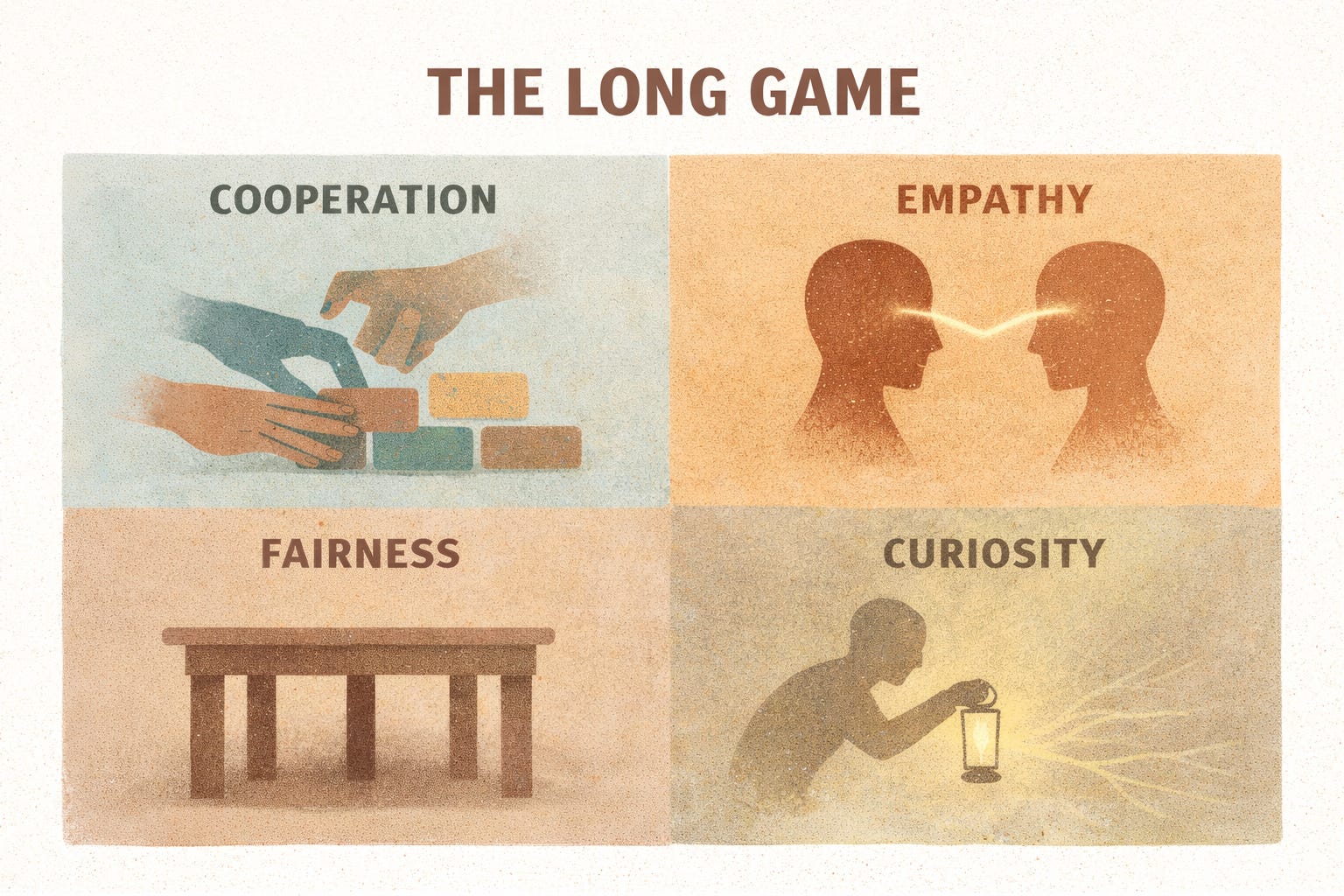
Over the past few posts on the main CODA Project site, we’ve been working through a simple but uncomfortable idea: progressives have been playing the wrong game.
For decades, we’ve focused on winning arguments, calling out hypocrisy, and reacting to the latest outrage. Meanwhile, a very different strategy has been unfolding—one that prioritizes long-term influence over short-term victories, infrastructure over headlines, and discipline over emotional release.
The rise of MAGA was made possible by what’s been done by ultra-conservative operatives and think tanks, as well as large corporations and the investment class. Even though MAGA is unlikely to be a lasting phenomenon, the inequitable groundwork these “Alpha” conservatives have laid will make it easier for another rightwing movement to take its place.
If progressives and people of good will are serious about building something that lasts, we have to shift our approach. That doesn’t mean abandoning our values. It means learning how to apply them strategically, consistently, and at scale.
The four posts in this series weren’t just me doing my typical navel-gazing. They were my attempt to translate four of our foundational human values—cooperation, empathy, fairness, and curiosity—into something more durable. Something that can hold under pressure. Something that can actually compete with the opposition’s long-game strategy that’s built on dominance and control.
But before we move into the next phase, let’s take a moment to reset and reconnect with the core ideas.
1. Cooperation is a Clandestine Operation
If the Alpha strategy thrives on division, then cooperation becomes quietly subversive.
This post challenged the idea that we need perfect alignment before we can work together. Instead of searching for “common ground” built on shared beliefs, we focus on a common floor… basic conditions of safety, dignity, and mutual interest that allow people to collaborate without agreeing on everything.
The key shift is this: cooperation is not weakness. It’s discipline. It requires restraint, patience, and a willingness to build something alongside people who don’t see the world exactly the way you do.
READ: Part 1 of the Long Game: Cooperation over Competition
2. Empathy as a Subversive Act
Empathy has been framed as soft, passive, or even naïve. In reality, it’s one of the most disruptive forces available to us.
This post reframed empathy as proximity with purpose… a deliberate choice to move toward people who are being “othered,” and to understand what is at stake for them. It’s not about agreeing or offering excuses. It’s simply about removing the distance that makes dehumanization possible.
The takeaway is simple but powerful: the systems we’re pushing against rely on separation. Empathy closes that gap and, in doing so, it undermines the entire structure.
READ: Part 2 of the Long Game: Empathy as Subversion
3. Fairness vs. The Throne
Dominance systems depend on hierarchy. They depend on the idea that some people should have more power, more voice, or more worth than others.
This post contrasted that mindset with a fairness-based approach that focuses on building foundations instead of thrones. Rather than competing for position or control, the goal is to distribute power, share responsibility, and create systems that are stable because they are just.
Fairness, in this sense, is not about optics or outcomes alone. It’s about how power is structured, and whether it serves the whole or concentrates at the top.
READ: Part 3 of the Long Game: Fairness as the Foundation
4. The “Opened Ear” is Curiosity Over Dogma
Certainty feels strong, but it often locks us into rigid thinking. Curiosity, on the other hand, keeps us adaptable.
This post positioned curiosity as a discipline, not a personality trait. It is the willingness to ask better questions, to examine assumptions (including our own), and to stay open long enough to actually understand what’s in front of us.
Dogma creates cages, sometimes even when we believe we’re on the “right” side. Curiosity keeps those cages from forming in the first place.
READ: Part 4 of the Long Game: Curiosity over Dogma
What Comes Next
This series has been about shifting how we think. The next phase is about how we act.
Because values, on their own, don’t build anything. They need structure. They need discipline. And they need to show up in real decisions, real conversations, and real communities.
So we’re going to start practicing.
Each week, we’ll take one piece of the Long Game and turn it into something concrete—something you can try in a real conversation, a real relationship, or a real moment of tension. At the same time, we’ll pair that with simple, practical actions you can take right now, such as calls, emails, and small moves that push back on the issues that matter most.
The goal isn’t perfection. It’s repetition. We need to start building the kind of habits that hold under pressure.
If the Long Game makes sense to you, the next step is simple:
Let’s start putting it into practice.