

I’ve been thinking a lot about what it actually means to be American.
People talk about it constantly. Patriotism. Loving your country. Defending “our way of life.” But when you stop and really ask the question—what does it mean to be American, exactly?—the answers get surprisingly fuzzy.
“American” is not short-term
It’s not nationalism and protectionism. Or at least, it shouldn’t be. Nor is it the greedy expansionism the Administration seems to be eyeing recently in “our hemisphere.” Or at least, it shouldn’t be!
We are one country in a very large, deeply interconnected world. And we’re not just any country, we’re an extremely powerful one. That power brings responsibility. Not only to our own people and our allies, but to the flourishing of human beings everywhere. Being an international “schoolyard bully” ignores that responsibility.
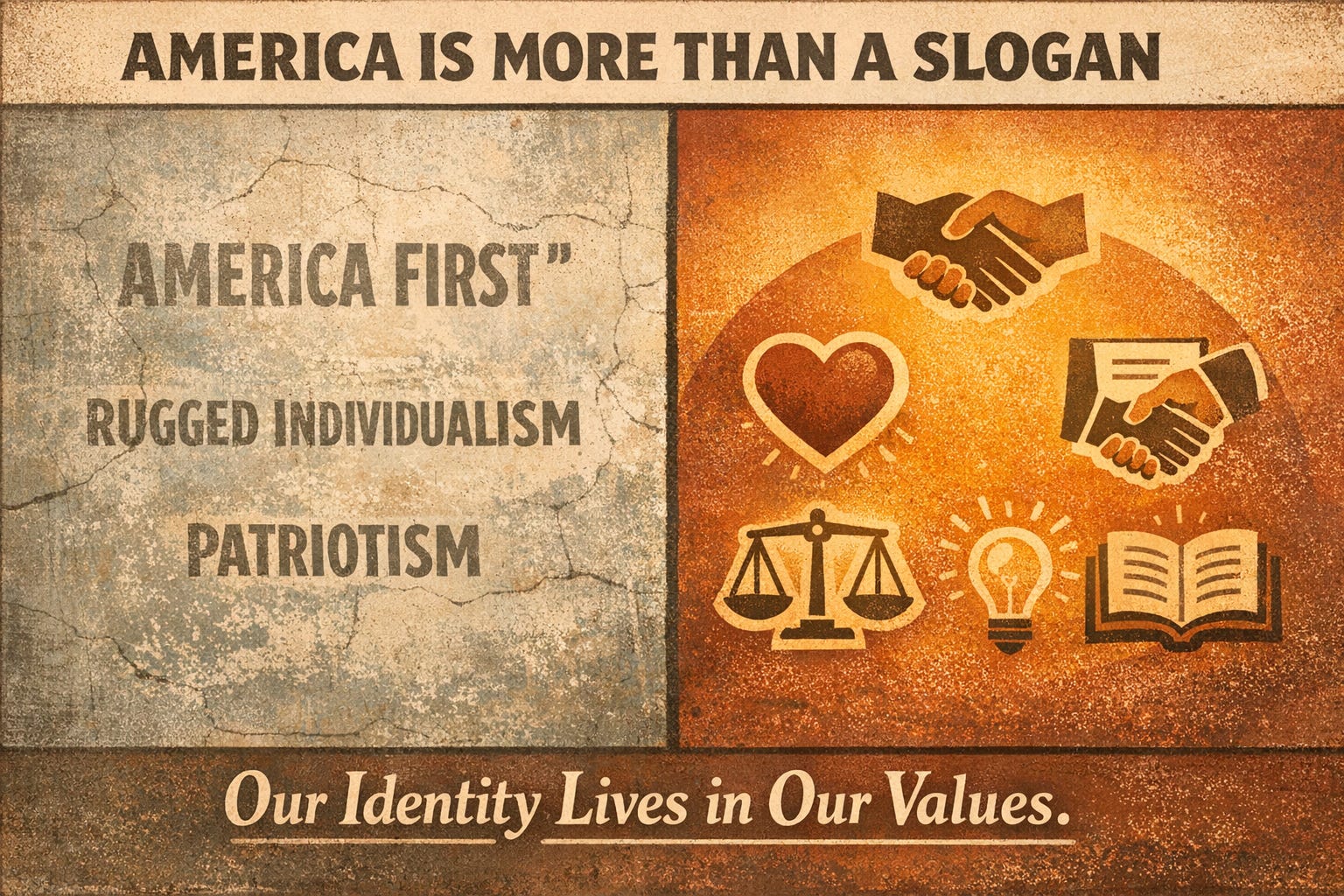
Slogans like “America First” may sound intuitive to some people, but they’re ultimately selfish, dangerous, and when you look closely, they’re logically incoherent.
America first when? Over what timeframe?
Short-term thinking often feels satisfying, but it regularly causes long-term harm. Take tariffs. Yes, they can generate revenue in the near term. But they also disrupt global supply chains and end up punishing countless small and mid-sized U.S. businesses that rely on imported materials and components or easier access to international markets.
Or take foreign aid. People understandably bristle at helping other countries when so many Americans are struggling. But stabilizing fragile nations helps real people and it also creates future allies and trading partners. Over time, that cooperation strengthens everyone involved, including us.
So even on its own terms, “America First” turns out to be an unclear and self-defeating idea.
“American” is not individualistic
Another common answer people reach for is “rugged individualism.” But that doesn’t hold up either.
The concept grew out of America’s frontier experience, where self-reliance was often necessary for survival. The phrase itself was popularized by President Herbert Hoover in 1928 as a political philosophy opposing government intervention and contrasting the U.S. with European collectivism. It became a major talking point during the Great Depression, especially in opposition to Franklin D. Roosevelt’s New Deal.
Here’s the problem: almost everything we love about modern American life directly contradicts “rugged individualism.”
Social Security. Medicare and Medicaid. Insurance of any kind. Public schools. Paved roads. Police and fire departments. Clean water systems. Courts. Consumer protections.
None of that exists without collective effort and shared responsibility.
So no, “rugged individualism” is not what defines us as American.
Others point to our rights: free speech, freedom of religion, the right to bear arms. Important? Absolutely. But uniquely American? Not really. And taken alone, they still don’t explain what it means to be American.
So what does?
Have we forgotten? Or did we never know?
Honestly, I think we’ve forgotten. Or maybe we never really defined it clearly in the first place.
That lack of clarity may explain why we’re so divided today. Without a shared rubric for what “being American” actually entails, it’s hard to recognize when we’re drifting off course; and it’s even harder to agree on how to correct it.
And yes, there are plenty of people right now who don’t seem especially concerned with what’s right or with the broader responsibilities of citizenship. Some are driven primarily by grievance, fear, power, or personal gain. Some are openly hostile to pluralism, equality, and democratic norms. Many act as though the world owes them something, while they owe nothing in return.
That may be an identity. But it isn’t an American one.
To figure out what is, I think we need to look backward—not nostalgically, but honestly. We should ask what allowed a loose collection of English colonies to become, in just a few centuries, the richest nation and most influential power the world has ever seen.
This is where the Foundational Values Framework comes in.
America was built on Foundational Values
The idea is simple: beneath all our laws, institutions, and cultural myths are a small set of values that, when we actually live them, drive human flourishing. When we drift away from them, things start to break.
Those values are cooperation, empathy and compassion, fairness and justice, integrity and honesty, and curiosity and learning.
Cooperation came first. The Founders didn’t agree on everything. Far from it. But they came together to debate ideas and principles that could support a durable, evolving nation. They intentionally built a system that was not only fair for its time but flexible enough to grow and change, adapting to an ever-changing world. They understood that the Declaration of Independence and the Constitution were powerful civic achievements, but they were not perfect or divinely inspired documents frozen for eternity.
Empathy and compassion, expanded through personal and communal struggle and learning, allowed us to confront moral horrors like chattel slavery and eventually abolish it while holding the Union together.
Fairness and justice resurfaced again and again: in women’s suffrage, the civil rights movement, labor protections, and today’s ongoing fight against authoritarianism dressed up as nostalgia.
Integrity and honesty made capitalism workable. Contracts mattered. Courts enforced rules. Governments restrained monopolies (at least for a time). These same values fueled the labor movement, creating a counterweight to concentrated corporate power.
And curiosity, paired with learning, drove innovation and progress. Whenever wealth and power began to calcify in the hands of a few, people rediscovered these values and pushed for creative, corrective change.
That pattern is unmistakable.
So when I ask what it means to be American, my answer is this: being American means striving to live these Foundational Values.
Not perfectly. No individual can do that, let alone an entire nation. But repeatedly. Intentionally. Collectively.
Being “American”
When we act in ways that honor cooperation, empathy, fairness, integrity, and curiosity, we’re participating in the best of the American tradition. When we abandon those values—when we excuse cruelty, normalize dishonesty, hoard power, or shut down learning—we’re not being patriotic. We’re being un-American.
If we claim to “cherish” something, it should be traceable back to these Foundational Values. When we hold tight to ideas from the past, it should be because we haven’t yet developed new ideas that better align with these values. There is no specific virtue in clinging tightly to the past simply because “it’s always been that way.” America was built on forward-looking innovation, not backward-looking nostalgia.
Perhaps the most important work we can do right now is to clearly articulate what we stand for, and to recognize ourselves in these Foundational Values again. Not as nostalgia. Not as myth. But as a shared moral identity.
The Foundational Values Framework can help us do that. It works for examining sacred texts, cultural stories, and personal choices. And it works just as well for evaluating our national history, our present behavior, and the future we’re trying to build.
Our identity as Americans doesn’t live in slogans or symbols.
It lives in the values we choose to practice… together.