


Did you know that in ancient Rome, refusing to worship the state made you an “atheist.” It’s an interesting historical bit of trivia… but it’s not exactly trivial… because today, something similar is happening again. I think it’s worth taking some time to explore how modern movements are blending religion and nationalism, and why defending pluralism may be the most important act of civic courage in our diverse society!
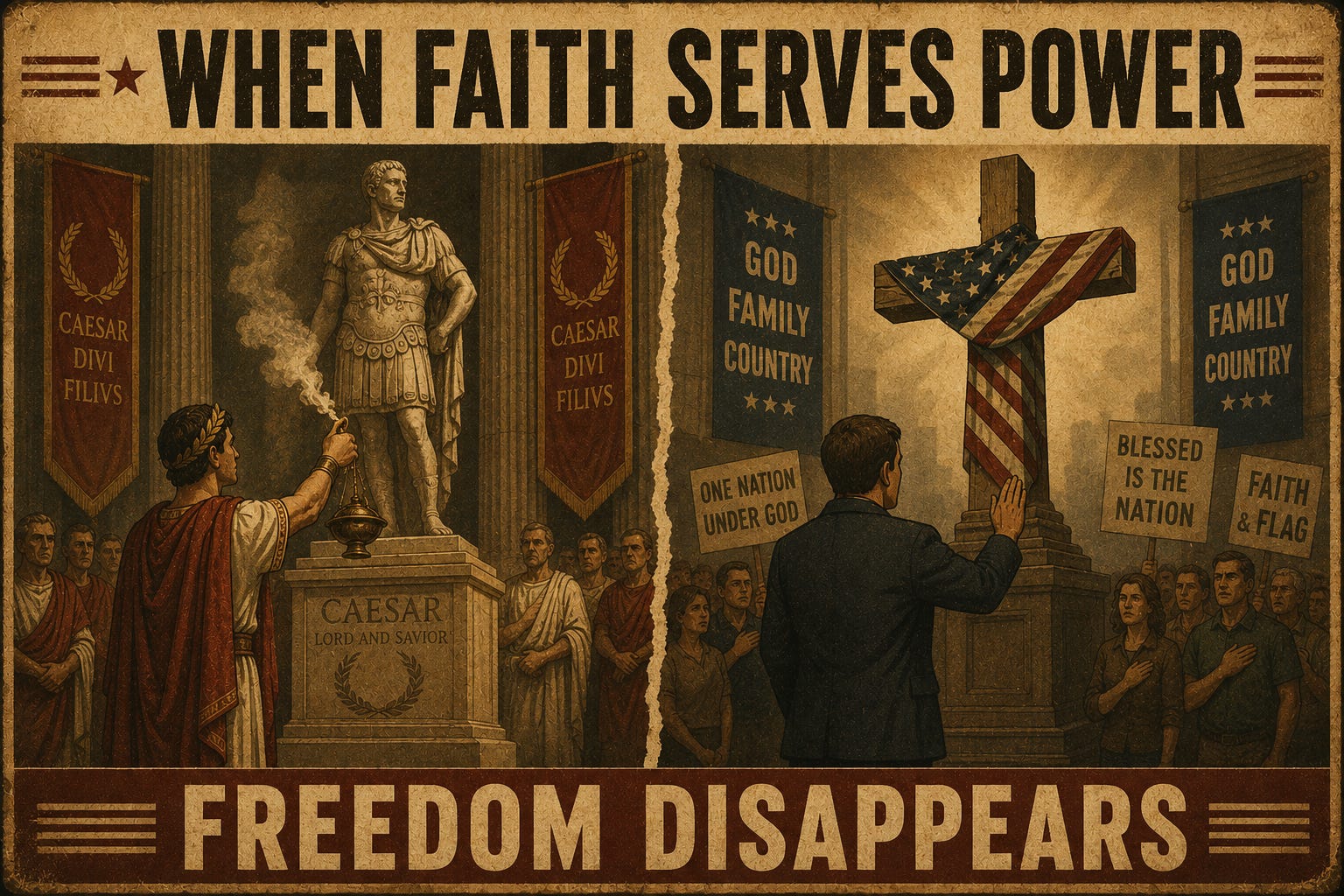
Let’s start with a little historical irony, because it’s one of those details that should make you pause for a second. In the Roman Empire, the early Christians were called atheists. Not because they didn’t believe in anything supernatural, but because they refused to participate in the official religious system of the state. They wouldn’t burn incense to Caesar. They wouldn’t affirm that the emperor was divine. And in a society where religion and government were fused together, that wasn’t just seen as quirky… it was seen as dangerous.
From the Roman perspective, this wasn’t about personal belief. This was about loyalty. Religion was the glue that held the empire together. It was a shared ritual, a public performance of unity. So when a group of people said, “No, we’re not doing that,” the Romans didn’t interpret that as “we have a different faith.” They heard, “We don’t recognize your authority.” And that made those earliest Christians, in the eyes of the state, a threat to national security.
Now here’s where it gets interesting from a human perspective. The early Christians weren’t executed for being kind or generous or loving their neighbors. They were executed because they refused to worship power. They rejected the idea that the state (or any ruler) deserved ultimate loyalty. And in doing so, they exposed something that empires don’t like to admit: that their authority depends, at least in part, on people playing along.
So, let’s dive into that… in this episode of Afterthoughts!


